

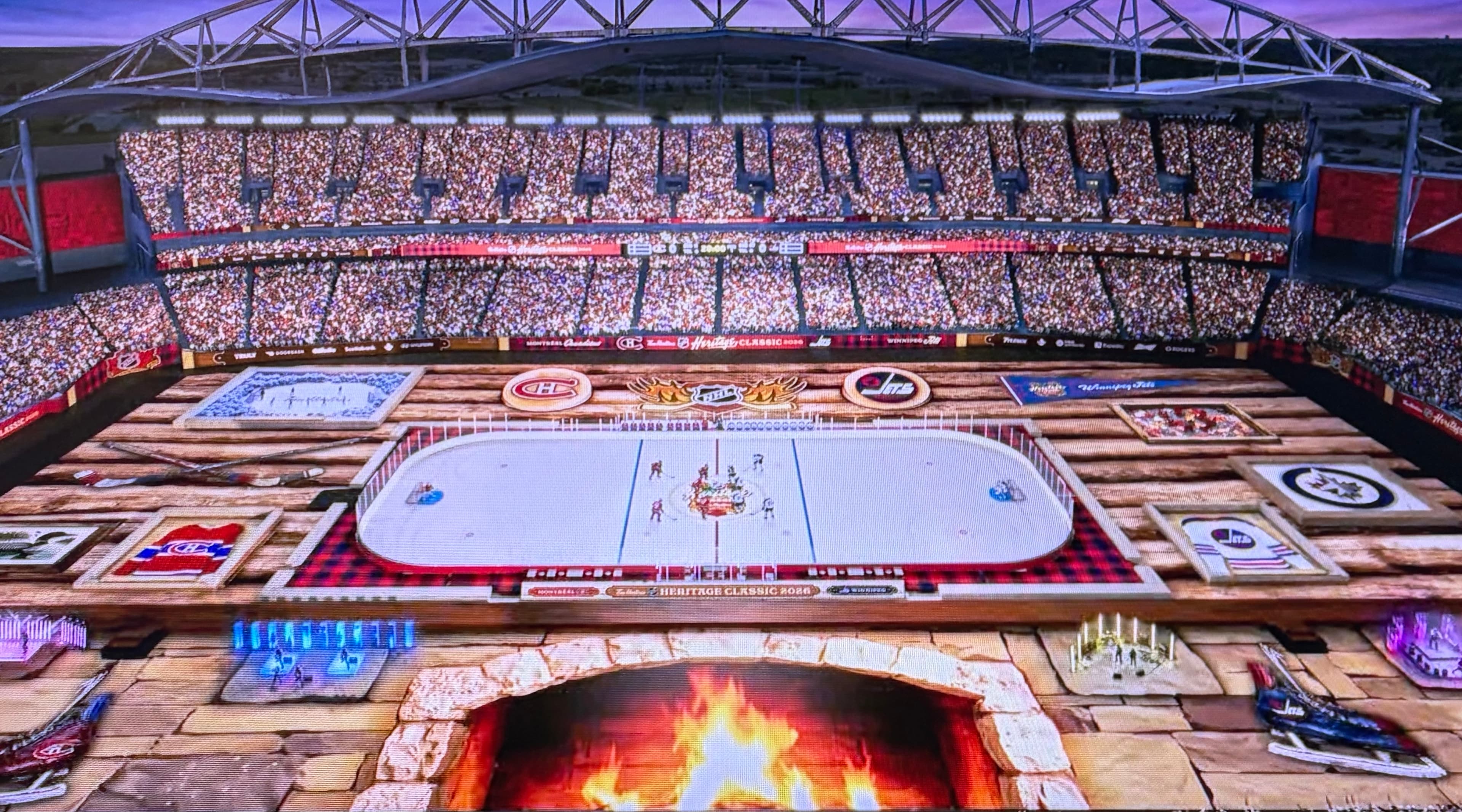

From a Canadian cabin to four concert stages, a giant Jets logo and a spectacular outdoor hockey production, the NHL's President of Content and Events is preparing to turn the 2026 Heritage Classic into something Winnipeg has never seen before.
Steve Mayer isn't coming to Winnipeg to put on a hockey game. He's coming to put on a show. A very big show.
A spectacular, uniquely Canadian, made-for-television, made-for-Winnipeg extravaganza that just happens to feature two of the most storied franchises in National Hockey League history playing an important regular-season hockey game.
And if the NHL's President of Content and Events gets his wish, the 2026 Heritage Classic at Princess Auto Stadium on Sunday, October 25, will be remembered for a whole lot more than the final score between the Winnipeg Jets and Montreal Canadiens.
There will be music. There will be entertainment. There will be history, nostalgia and enough Canadian imagery to make even the most hardened hockey traditionalist smile. There will even be a cabin.
Yes, a cabin.
And that's just the beginning.
"We've been working on the field design for close to a year," Mayer said as preparations continued for the NHL's return to Winnipeg. "We went back and forth because, as you'll see, it replicates the wall of a cabin, which we felt was part of the heritage of the Canadian landscape.
"We're really excited about this one. It pops. It looks amazing from a television standpoint. We think this one is going to be one of our better-looking field designs, and we're really excited to be here in Winnipeg."
For Mayer, whose job involves overseeing some of the NHL's most ambitious events, this year's Heritage Classic represents something considerably more significant than simply putting an ice rink in the middle of a football stadium.
It's an opportunity to celebrate Canadian hockey culture, showcase Winnipeg to an international television audience and demonstrate just how far the NHL's outdoor-game productions have advanced over the past decade.
And make no mistake, the NHL intends to make a statement.
A Canadian cabin, a Winnipeg Jet and four bands
At the heart of the Heritage Classic presentation is an elaborate field design inspired by something familiar to Canadians from coast to coast: The cabin. Or the cottage. That traditional gathering place where families share stories, friends celebrate special occasions and hockey memories are passed from one generation to another.
For Mayer and his creative team, it provided the perfect foundation for a celebration of Canadian hockey heritage.
"The cabin-cottage culture is a part of Canada," Mayer explained. "We just felt it's a place that we hadn't gone before. When we do these outdoor games in Canada, the Heritage Classic, we really lean into the history and we try to bring as much of Canada into the fold."
The design will incorporate elements representing Manitoba, Winnipeg, Quebec, the Canadiens and the history of the Jets. It will also celebrate the organization's connection to its past, including the return of imagery associated with the original Winnipeg Jets.
One particularly interesting feature will be a three-dimensional representation of the jet from the team's logo.
"In one of the frames, it's the actual Winnipeg Jet logo," Mayer explained. "And the jet, we've built a jet that will be on the field. It's hard to tell because it looks pretty flat, but the frame that's far right is 3D in nature."
And the field won't simply be something attractive to look at. It will be alive.
There will be activity throughout the game, including a fire pit with people gathered around it, creating the atmosphere of a genuine Canadian outdoor gathering.
Broadcasters will use the setting for television segments, and the various displays will become part of an interactive production designed to keep fans entertained throughout the afternoon.
But perhaps the most ambitious element of the entertainment package is the music.
For the first time in an NHL outdoor game, four bands are scheduled to perform during a single intermission presentation.
"It is the first time in one of our outdoor games that we're not going to have one band, we're not going to have two bands, we're actually going to have four bands perform in a medley during our intermission," Mayer said.
The production will include four distinct stages integrated into the field design.
And that won't be the only music.
Mayer said the NHL is also embracing the tradition of Canadian kitchen-party entertainment, bringing a distinctly homegrown atmosphere to the proceedings.
The result should be a stadium that feels part hockey rink, part concert venue and part Canadian family gathering.
For Mayer, that's precisely the point.
Ten years later, a completely different experience
Winnipeg last hosted the Heritage Classic in 2016.
At the time, the event was an enormous undertaking and represented a significant step forward in the NHL's approach to outdoor hockey.
But a decade is a long time in the world of sports entertainment.
And according to Mayer, the league's production capabilities have changed dramatically.
"I think one of the things that we've done since the last time we were here 10 years ago is these outdoor games have become very interactive," he said.
"Every single commercial break for television, we activate something on the field. So there's always something to look at, which we find to be really interesting and definitely a big difference from the last time we were here."
That change is particularly important in an era when professional sports leagues are competing for attention across traditional television, streaming services and social media.
The NHL understands that staging a memorable hockey game is only part of the challenge.
The event must also capture the imagination of viewers who might otherwise be watching something else.
And Mayer believes the Heritage Classic is perfectly suited to that challenge.
"We want people around the world to tune in and know where they're watching the game from," he said.
"It's not a Winnipeg local game, although that's what the crowd will be cheering for. It's a game that's seen around the world in so many countries."
That international audience is one reason the league invests so heavily in its outdoor productions.
Mayer said the NHL is staging three outdoor games this season, describing them as the league's biggest regular-season events.
"They're our three biggest games of the year, by far, in the regular season," he said. "Most watched, most talked about, and the most effort that we at the league put behind these games."
It's also why Winnipeg's second Heritage Classic has been designed to look and feel substantially different from the first.
In 2016, the NHL used an enormous graphic to cover the football field, creating an impressive visual presentation around the temporary hockey rink.
At the time, it was considered groundbreaking.
Today, Mayer says, the league has moved far beyond flat graphics.
"We've advanced from graphics to where we've built essentially a set," he explained.
"It's got a lot of dimension. We take advantage of high, high walls. We actually get way more creative now than we did back then."
In fact, Mayer recalled that the 2016 Winnipeg event marked an important milestone in the development of NHL outdoor-game presentations.
What seemed revolutionary a decade ago has now become standard practice.
And that progress has raised expectations.
"We realize it's the crowd that's here that we have to blow away," he said. "We want people to walk in the stadium and go, 'Wow.'"
That's the standard.
Not simply a good afternoon of hockey.
An unforgettable afternoon of hockey.

Princess Auto Stadium on Monday (Photo by Scott Taylor)
A year of preparation and 150 people behind the scenes
Of course, transforming a football stadium into an NHL hockey venue and elaborate entertainment production doesn't happen overnight.
It doesn't happen in a week, either.
For Mayer and his team, preparations have been underway for approximately a year.
And by the time the puck drops, roughly 150 people will have contributed to bringing the event to life.
"In the end, we probably have around 150 people that have worked on this around the clock for a year," Mayer said.
The undertaking involves an extraordinary collection of specialists.
There are security personnel, credentialing teams, transportation coordinators, hospitality professionals and hotel organizers.
There are people responsible for getting the Jets and Canadiens into the stadium, others responsible for VIPs and special guests, and still others whose entire assignment involves coordinating the pregame festivities.
There are field designers, signage crews, branding specialists and entertainment producers.
And, of course, there are the hockey operations people.
All of them must work together, often on extremely tight schedules, to ensure that every element is ready when the stadium gates open.
For Mayer, one of the most satisfying parts of the process is the relationship that has developed among the people responsible for these enormous productions.
"This is a team," he said. "We've been working together as a team for so many years now, and we finish each other's sentences.
"We really love each other."
As the event approaches, crews arrive in Winnipeg from different locations, bringing equipment, expertise and considerable experience.
Mayer joked that Winnipeg restaurants should prepare for a busy week.
"Your restaurants in Winnipeg are going to be packed," he laughed.
But beneath the humour is an unmistakable sense of pride.
These are people who have devoted much of their professional lives to producing some of the most unusual events in hockey.
And for many of them, the opportunity to return to Winnipeg is something they've been eagerly anticipating.
"This is what we sort of yearn for, live for," Mayer said. "We're really happy that it's only a few days away."
The most important man might be the ice guy
With all the talk of cabins, concert stages, television production and elaborate entertainment, Mayer is quick to point out that there is one element of the Heritage Classic that matters more than everything else.
The ice.
Because no matter how spectacular the surroundings, the Winnipeg Jets and Montreal Canadiens still have an NHL game to play. And that game counts.
"The hockey game is worth the same amount of points as any regular-season game," Mayer said.
"That ice has to be fantastic. That ice has to be NHL ice."
The responsibility for making that happen rests with the league's ice-making specialists, including Derek King, the Winnipeg native whom Mayer praised as one of the very best in the business. For someone with local roots, preparing the ice for a Heritage Classic in Winnipeg carries special significance.
"This, for Derek, is huge," Mayer said. "He's from Winnipeg. This is so big for him."
The ice crew must work around an extraordinary schedule of rehearsals, ceremonies and entertainment presentations. At various points during the week, the production team needs access to the rink for staging and practice. But Mayer stressed that everyone understands the priorities.
The ice crew gets what it needs. The entertainment team works around it. And the entire operation functions through careful coordination.
"We all know our spots and what needs to be done," Mayer said. "We work in tandem.
"We know when he needs to have the ice. We know when we can use the ice for things that we're going to do."
The opening ceremonies will make use of the rink itself, and Mayer promises they will be substantial. But the priority never changes.
"What he's building is essential and the most important piece of a Heritage Classic."
It's a useful reminder that, for all the spectacle surrounding these events, the NHL's outdoor games remain legitimate professional hockey contests. And the players deserve the best possible conditions.
Winnipeg has changed. So has the NHL.
One of the challenges facing Mayer and his colleagues is the simple fact that Winnipeg has already experienced a Heritage Classic. The novelty of bringing NHL hockey outdoors is no longer entirely new. And that means the league must work harder to create something different.
Mayer understands the expectations.
"I think the pressure was on the second we announced that we're coming back," he said. "First of all, this is an avid fan base. They love their Jets."
But the NHL isn't simply returning with a familiar product. It's returning with a decade of additional experience. That includes changes to the game schedule, designed in part to avoid the sunlight issues that can complicate outdoor hockey. It also includes the more sophisticated entertainment production, interactive field design and greater integration between the in-stadium experience and television broadcast.
Mayer believes those improvements will be obvious to anyone who attended the 2016 event.
"We've learned a lot," he said. "As a team of the NHL, as an events team, we've grown dramatically."
The league is also approaching the event with an understanding that sports fans have more entertainment options than ever before. A television viewer can change channels in an instant. A social media user can scroll past a highlight without a second thought. Capturing attention has become an increasingly important part of staging major sporting events.
"We're living in a sports-cluttered place where there's so much on," Mayer said. "How do you get people's attention?
"We think these outdoor games do just that."
For Winnipeg, the opportunity is enormous.
The city will be showcased to hockey fans well beyond Manitoba.
The Jets will be featured in one of the NHL's signature regular-season events.
And Princess Auto Stadium will become the centre of a production designed to celebrate both the history of Canadian hockey and the modern entertainment possibilities of the sport.

From the middle of the second deck: The best seat in the house (Photo by Scott Taylor)
Why outdoor hockey still matters
Perhaps the most interesting part of Mayer's perspective has nothing to do with television ratings, elaborate sets or entertainment budgets.
It has to do with memory.
The NHL has spent years bringing hockey back outdoors, reconnecting the professional game with the frozen ponds, backyard rinks and neighbourhood ice surfaces where generations of Canadians first learned to skate.
But the hockey world has changed.
Many young players now spend most of their development years in indoor arenas.
Some have limited experience playing outdoors.
And yet, remarkably, the romance of outdoor hockey remains as powerful as ever.
Mayer believes that even a brief childhood experience on an outdoor rink can create a lasting emotional connection.
"If you listen to the players, every one of them to a person always says, 'That reminds me of growing up,'" he said.
Even if those players spent most of their childhoods in organized indoor hockey, there is often one special memory.
A frozen pond.
A backyard rink.
A game with friends.
A bitterly cold afternoon when nobody wanted to go home.
"It's that touch, it's that moment, it's that memory that they had when they did play outdoors," Mayer said.
And that, perhaps more than anything else, explains why the Heritage Classic continues to resonate.
It's a celebration of something deeply connected to Canadian identity.
Not simply professional hockey.
But the experience of playing hockey outside.
Mayer has witnessed that connection firsthand while travelling to cities hosting NHL outdoor games.
He hears about it from taxi drivers, restaurant employees and ordinary fans.
And in Winnipeg, he has discovered a community where the excitement is impossible to miss.
"There's no one here that doesn't know what's happening," he said.
"That, to me, is why we still do these games and why they generate the excitement that they still have that aura to them."
It's an aura that can't necessarily be manufactured.
The NHL can build the stages, design the field, install the rink and produce the television spectacular.
But the emotional connection belongs to the fans.
And that connection is particularly strong in a hockey city such as Winnipeg.
The future might be even more spectacular
As ambitious as the 2026 Heritage Classic promises to be, Mayer is already thinking about what comes next.
The NHL continues to experiment with outdoor hockey and the possibilities of taking its games to unusual locations.
And with the league approaching its 50th outdoor game next season, there is no indication that the concept is losing its appeal.
"We're about to do next season our 50th outdoor game," Mayer said. "Fiftieth. It's kind of hard to believe, but it's a gift that keeps giving."
What might the future hold?
Perhaps outdoor games staged at famous landmarks.
Perhaps more unusual settings.
Perhaps productions that move away from the massive stadium experience and return to something simpler.
Mayer finds the possibilities fascinating.
"There's a rawness to this," he said. "We're in a stadium and we are braving the elements, but can we even strip it down a little more?
"Is the next iteration going to some really unique places and playing in landmarks?"
He believes that could be one direction for the league.
And social media has only increased the appeal of unique outdoor hockey experiences.
Spectacular backyard rinks, unusual frozen ponds and picturesque skating locations attract enormous attention online.
They remind people that hockey doesn't always need a giant building, expensive equipment or thousands of spectators to be special.
Sometimes, all it needs is a sheet of ice.
That simplicity is part of what the NHL is trying to capture, even while surrounding its outdoor games with increasingly elaborate productions.
It's a fascinating contradiction.
The league is spending enormous amounts of time, effort and creative energy to recreate the atmosphere of something Canadians have been doing for generations.
Playing hockey outside.
And somehow, it works.
People love it.
The players love it.
And Mayer's team loves bringing it to life.
"We love putting these games on," he said. "We'll see what the future brings, but I think it translates to just the hockey player who likes to play outside as well."
One city. Two legendary teams. One unforgettable afternoon.
When the Winnipeg Jets and Montreal Canadiens take the ice at Princess Auto Stadium on October 25, there will be plenty at stake.
Two valuable points.
Pride.
History.
And another chapter in one of the NHL's most celebrated outdoor traditions.
But surrounding that hockey game will be something far bigger than the scoreboard.
There will be a Canadian cabin, a three-dimensional Winnipeg Jet, four concert stages and a field filled with memories of the game Canadians grew up loving. There will be thousands of fans celebrating the return of outdoor NHL hockey to Winnipeg. And there will be a television audience watching from around the world.
For Steve Mayer and his team, the objective is straightforward: Make the people in the stadium feel that they've witnessed something extraordinary. Make the people watching on television wish they were there. And remind everyone why hockey played outdoors remains such a special part of the Canadian sporting experience.
After a year of planning, countless design revisions and the efforts of approximately 150 people, Mayer believes the NHL is ready. Winnipeg is ready. And the Heritage Classic is almost here.
Now all that's needed is a puck, a pair of skates and a little October magic. Because when the Jets and Canadiens meet under the Manitoba sky, the NHL won't simply be taking hockey outdoors.
It will be bringing hockey home.



Comments