


The next great Winnipeg hockey player might not be sleeping in anymore.
Instead, that youngster could be pulling on skates, grabbing a stick and heading to Eric Coy Arena for an early-morning workout before the first school bell rings.
And thanks to the Charleswood Hawks and Jets Hockey Development, that youngster might also be discovering something far more important than a better wrist shot.
The pure joy of playing hockey.
In one of the more interesting grassroots hockey initiatives in Winnipeg, the Manitoba Major Junior Hockey League's Charleswood Hawks have partnered with Jets Hockey Development (JHD) and École Charleswood School to launch the Junior Hawks program, an affordable, once-a-week, before-school hockey development opportunity for youngsters of all skill levels.
It's a program that's been five years in the making, and for Hawks president Tim Scharer, it's about much more than developing better hockey players.

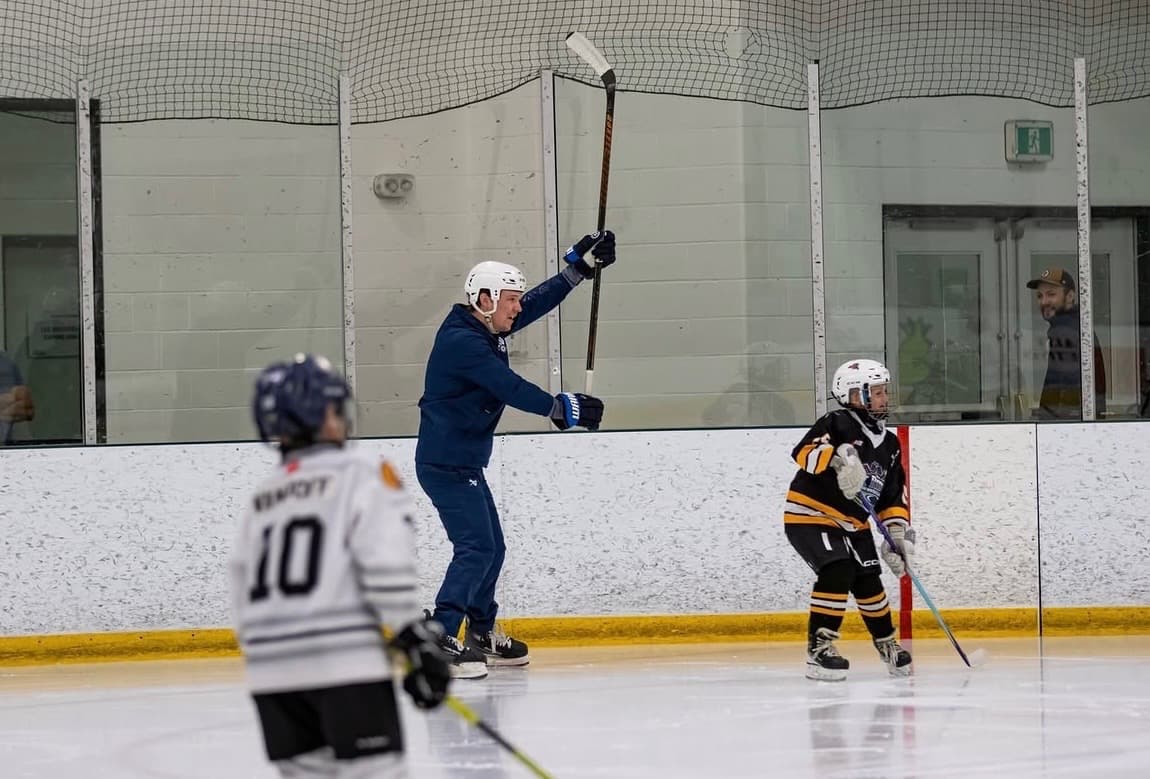
Max Gardiner at hockey for all centre (Photo by Carlos Lopez)
It's about bringing hockey home.
"We've been a community-run organization for 56 years now," said Scharer. "And we need to get back into those roots of giving back to the community."
For Scharer, the opportunity was almost too obvious to ignore.
École Charleswood School sits practically next door to Eric Coy Arena, the home of the Hawks. There were young hockey players attending school just a short walk from the rink, and an established junior hockey organization looking for ways to strengthen its community connections.
All that was missing was a program to bring them together.
Scharer had been working on the idea for roughly five years, but school schedules, coaching commitments and logistics repeatedly got in the way.
Then along came Max Gardiner.
A Charleswood kid himself, Gardiner attended Westdale and Oak Park, played four seasons with the Hawks and eventually moved into coaching at Oak Park. He later returned to the Hawks as an assistant coach.
And, perhaps most importantly, he works full-time with Jets Hockey Development.
Suddenly, Scharer had the missing piece.
"Max is kind of the connecting factor," Scharer explained.
Gardiner, who began helping coach the Hawks last season, understood both the organization and the community. He also had the professional hockey development background to help turn Scharer's long-standing idea into reality.
"The goal of this is to give kids a different option for skill development that is pretty reasonably priced,” Gardiner explained. “As well, there's not a huge demand time-wise since it's just once a week.
"At the same time we’re helping them be a little bit more aware of the quality of hockey that's right next door to them and trying to keep that hockey in the community as best we can."
That combination of affordability, accessibility and community involvement is what makes the Junior Hawks program special.
Unlike development programs that can demand considerable financial and family commitments, Junior Hawks is designed to fit into a child's existing school and hockey schedule.

Max Gardiner at work (Photo by Carlos Lopez)
The youngsters arrive at Eric Coy Arena before school, receive professional instruction on the ice and are then escorted directly to École Charleswood for the start of classes.
Simple. Convenient. And, judging by the opening session, already popular.
Sixteen young skaters participated on the program's first morning, representing a wide range of hockey abilities. There were A1 players, A3 players and female participants, all sharing the same ice and receiving instruction appropriate to their development.
For Scharer, that's precisely the point.
"We're going to develop this program so that if a kid's just at 10 years old, beginning to learn how to play hockey, we want to give him a few more skates with some good coaching and let him develop at his own pace," he said.
"But the biggest thing is we want this to have fun. It has to be fun for the kids."
It's a philosophy shaped by Scharer's own experiences as a hockey parent.
At 62, he's watched his children navigate the minor hockey system and understands that the pressures of competition can sometimes overwhelm the enjoyment of the game.
Junior Hawks is intended to provide something different.
There are no expectations that every youngster will become an elite player. No suggestion that hockey development must be an expensive, year-round undertaking.
Instead, the emphasis is on learning, improving, making friends and enjoying the experience.
And Scharer has even bigger plans.
Eventually, he'd like to expand the program beyond its current once-a-week format to offer specialized sessions Monday through Thursday.
That could include introductory hockey on Mondays, dedicated female development sessions on Tuesdays, AA and AAA development on Wednesdays and A1 through A3 sessions on Thursdays.
The idea is to create opportunities for virtually every youngster in the community, including those who might otherwise be intimidated by organized hockey.
There could also be benefits beyond the rink.
Scharer hopes to speak with teachers following the fall program to determine whether students participating in morning hockey sessions demonstrate improved classroom attention and readiness to learn.
It's an interesting possibility, although the program's educational impact has yet to be evaluated.
Getting the initiative started required cooperation from several organizations.
The school administration embraced the proposal when Scharer renewed discussions last spring, while Jets Hockey Development provided the coaching connection.
The City of Winnipeg also helped overcome an important obstacle: Eric Coy Arena wasn't normally open for early-morning programming, requiring additional arrangements for rink staffing.
Scharer credits everyone involved for helping make the program possible.
"Between the school, JHD, the city and us, this is what we need," he said. "And it's fantastic."
For Gardiner, the initiative represents another chapter in a hockey journey that has remained remarkably close to home.
From Westdale to Oak Park, from playing with the Hawks to coaching them, his career has been rooted in the same community where he grew up.
Now he's helping introduce another generation of Charleswood youngsters to the game.
And for the Hawks, there's an additional opportunity.
By welcoming local children onto their home ice, the MMJHL club can build relationships with young fans and families who might otherwise know little about the quality of junior hockey being played in their own neighbourhood.
Today's Junior Hawk could become tomorrow's Hawks supporter.
Or perhaps, one day, even wear the Hawks jersey.
But that's a story for another morning.
For now, it's about 16 youngsters, an early-morning skate, a few new skills and the chance to start the school day with a smile.
And in Charleswood, that's already a pretty big win.





Comments